Open Our Eyes

Most of us spend our lives seeing only what frightens us.
The servant of Elisha awakens to discover an army surrounding the city. What he sees is not an illusion. The danger is real. Yet it is not the whole reality.
Fear never tells the whole story.
So Elisha prays the simplest of prayers: "Lord, open his eyes."
Not, "Send help."
Not, "Remove the enemy."
Simply, "Open his eyes."
And suddenly the servant discovers that grace was already present. The mountain was full of horses and chariots of fire before he ever noticed them. God's presence did not arrive with the prayer. It was there all along.
Perhaps this is the deepest blindness of the human heart: not that we see things that are not there, but that we fail to see what is.
We see enemies and miss neighbors.
We see threats and miss opportunities for mercy.
We see scarcity and miss abundance.
We see ourselves as abandoned when all the while we are surrounded by the quiet presence of God.
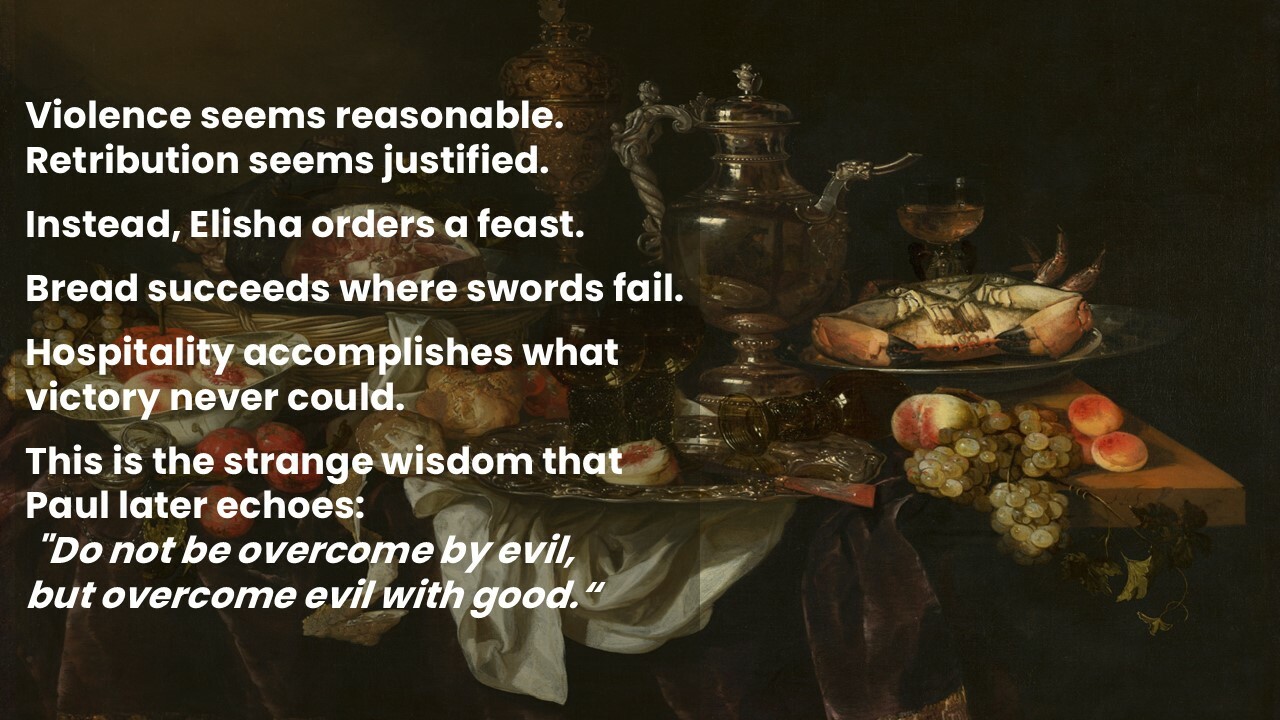
The story reaches its culmination not with the fiery chariots but with a meal. The captured army stands helpless before Israel's king. Violence seems reasonable. Retribution seems justified.
Instead, Elisha orders a feast.
Bread succeeds where swords fail.
Hospitality accomplishes what victory never could.
This is the strange wisdom that Paul later echoes: "Do not be overcome by evil, but overcome evil with good."
The world believes evil is defeated by greater force. The gospel suggests something more difficult. Evil begins to lose its power whenever fear gives way to trust, whenever hostility yields to compassion, whenever we recognize the image of God in the person we would rather dismiss.
The prayer of Elisha remains the prayer of the church:
Lord, open our eyes.
Open our eyes to the grace that surrounds us.
Open our eyes to your presence hidden in ordinary things.
Open our eyes to the humanity of those we have turned into enemies.
For when our vision is healed, our hearts may follow, and the world itself may begin to look different.