Wisdom for a Noisy World

Based on 1 Kings 3:16–28 and Luke 10:38–42
We live in a world filled with voices. Notifications chime, news headlines scroll endlessly, opinions compete for our attention, and our own worries often speak louder than anything else. In such a world, wisdom can feel elusive.
Yet when God appeared to Solomon and invited him to ask for anything, Solomon did not ask for wealth, military power, fame, long life, or success. Instead, he prayed for something much deeper:
"Give your servant therefore a listening heart." (1 Kings 3:9)
The Hebrew phrase Solomon uses is lev shomea'—literally, "a hearing heart" or "listening heart."
This phrase invites us into a richer understanding of wisdom than our modern culture often offers.
The Heart That Hears
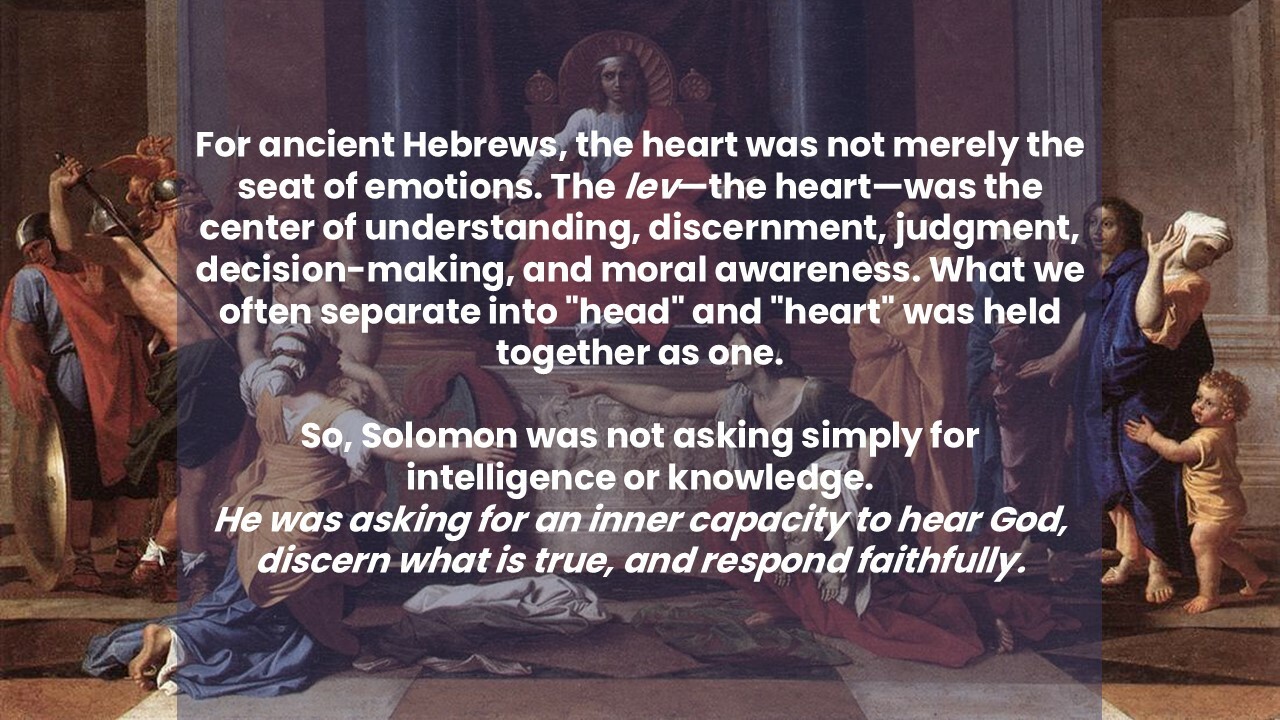
For ancient Hebrews, the heart was not merely the seat of emotions. The lev—the heart—was the center of understanding, discernment, judgment, decision-making, and moral awareness. What we often separate into "head" and "heart" was held together as one.
So Solomon was not asking simply for intelligence or knowledge. He was asking for an inner capacity to hear God, discern what is true, and respond faithfully.
Perhaps we might translate his prayer this way:
"Lord, give me a heart attentive enough to hear You."
What a remarkable request.
Before wisdom comes listening.
Before leadership comes humility.
Before action comes attentiveness.
Solomon's wisdom begins not with what he knows, but with his willingness to admit what he does not know. He confesses, "I am only a little child; I do not know how to go out or come in." His humility opens the door for God's wisdom.
The biblical pattern appears again and again:
Humility → Listening → Wisdom
Hearing Beneath the Words
The famous story that follows—the two women claiming the same child—is often presented as an example of Solomon's cleverness. And certainly there is wisdom in his judgment.
But perhaps the deeper lesson is not what Solomon said; it is what Solomon heard.
Everyone in the room heard the arguments. Solomon listened beneath them.
He heard grief.
He heard fear.
He heard desperation.
He heard the fierce love of a mother unwilling to see her child harmed.
The true mother revealed herself not by winning the argument but by choosing the life of the child over her own claim.
This is wisdom at its deepest level—not intellectual brilliance but compassionate perception.
A listening heart hears what logic alone cannot hear.
The Vocation of God's People
The king of Israel was meant to embody what the people themselves were called to become.
The ideal king was not first a warrior, politician, or administrator. The ideal king was someone who listened to God.
This echoes Israel's foundational prayer:
"Hear, O Israel..." (Deuteronomy 6:4)
The first command is not "think."
The first command is not even "obey."
The first command is:
Hear.
God's people are, above all else, a listening people.
That calling remains true today.
Mary and Martha: The Wisdom of Presence
The Gospel reading offers a beautiful companion to Solomon's prayer.
Martha is busy serving Jesus. Her work is important. Her hospitality is genuine. Yet she becomes distracted and anxious by all that needs to be done.
Mary chooses something different. Luke tells us she sat at the Lord's feet and listened to what He was saying.
Like Solomon, Mary chooses attentiveness before action.
The contrast is not work versus laziness.
It is not service versus spirituality.
It is:
- Distraction versus presence
- Anxiety versus attentiveness
- Activity versus listening
Mary embodies the lev shomea'—the listening heart.
She recognizes that before she can serve Christ well, she must first be present to Christ.
Three Ways of Listening
These two stories together suggest three dimensions of holy listening.
Listening to God
Like Solomon, we begin by praying for hearts that can hear God's voice amid the noise of our lives. Wisdom begins when we become quiet enough to listen.
Listening to Others
Like Solomon hearing the pain beneath the words of the two women, we are called to listen beyond surface conversations. We hear not only what people say but the hopes, fears, wounds, and longing hidden underneath.
Listening to Reality
Like Mary sitting at Jesus' feet, we learn to pay attention to the sacred possibilities of the present moment. God is often found not in the next task but in the holy reality unfolding before us.
A Prayer for Today
Our culture rewards quick reactions, strong opinions, and constant productivity. Scripture invites us onto a different path.
Samuel prayed:
"Speak, Lord, for your servant is listening."
Solomon prayed:
"Give me a listening heart."
Mary sat and listened at the feet of Jesus.
And Jesus himself repeatedly said:
"Anyone who has ears to hear, listen."
Perhaps the deepest form of wisdom is not acquiring more information but awakening to what God, our neighbors, and our own souls are already saying.
A listening heart is not passive. It is the beginning of wisdom. It is the beginning of compassion. It is the beginning of faithful action.
May that be our prayer this week:
Lord, give us a listening heart. And having listened, help us to love.