The Samaritan’s Gift: Recognition

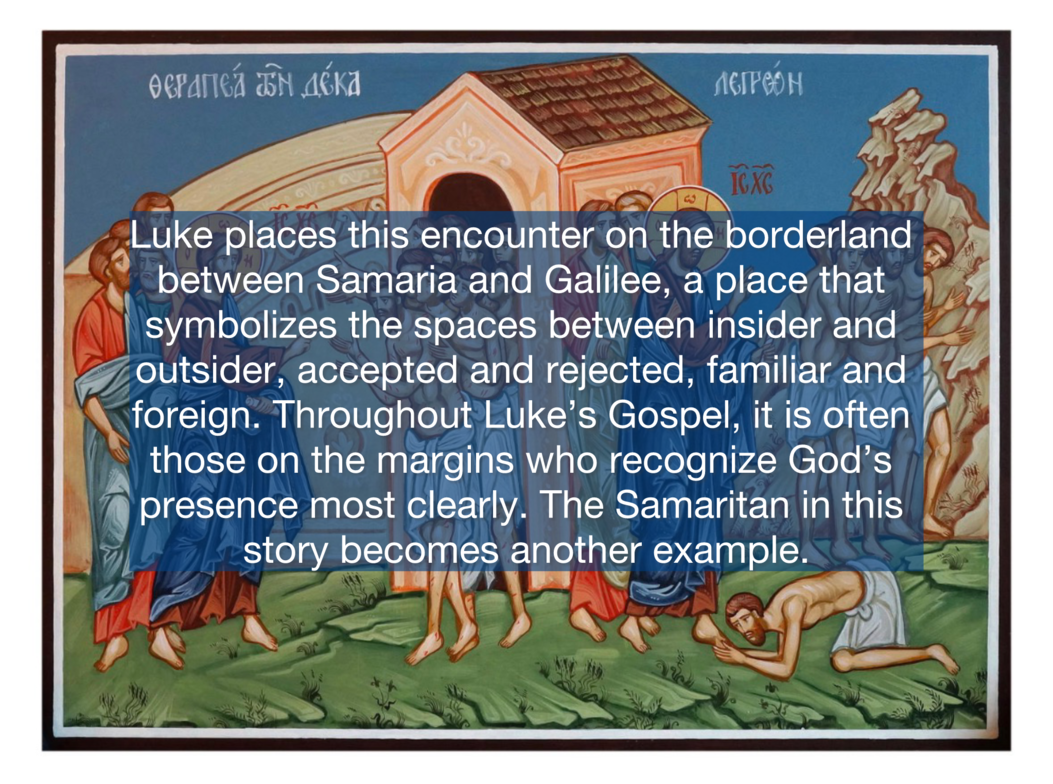
Most of us know the story of the ten lepers in Luke 17. Ten people, isolated by disease and pushed to the margins of society, cry out to Jesus for mercy. Jesus tells them to go show themselves to the priests, and as they go, they are healed. One returns to give thanks. Nine continue on their way.
Traditionally, this story is preached as a lesson about gratitude. Be thankful. Remember to say thank you. While gratitude is certainly part of the story, I wonder if Luke is inviting us to see something even deeper.
After all, the nine were not disobedient. They were doing exactly what Jesus told them to do. Perhaps they were hurrying home to embrace family members they had not touched in years. Perhaps they were eager to reclaim jobs, friendships, and a place in the community. Their healing changed everything.
Yet one man—a Samaritan, a foreigner, an outsider—stops.
He notices.
He turns around.
And in that turning, something remarkable happens.
Luke places this encounter on the borderland between Samaria and Galilee, a place that symbolizes the spaces between insider and outsider, accepted and rejected, familiar and foreign. Throughout Luke’s Gospel, it is often those on the margins who recognize God’s presence most clearly. The Samaritan in this story becomes another example.
The healing itself occurs almost in passing. “As they went, they were made clean.” Luke quickly moves beyond the miracle to focus on the response. One man sees that he has been healed and returns, praising God with a loud voice. The miracle is not simply that he is healed; the miracle is that he recognizes what has happened and who has made it possible.
Perhaps this story is really about the difference between relief and recognition.
All ten experienced relief. Their circumstances changed. Their suffering ended.
Only one experienced recognition. He saw beyond the gift to the Giver.
Many of us spend our lives praying for relief—for healing, provision, answers, solutions, reconciliation. There is nothing wrong with those prayers. Yet sometimes God’s greatest gift is not simply changing our circumstances but opening our eyes to God’s presence within them.
This theme echoes Jonah’s prayer from the depths of the sea. After running from God, Jonah finally recognizes a truth that had been there all along: “Deliverance belongs to the Lord.” Jonah turns. The Samaritan turns. Both discover that grace is not merely about rescue; it is about awakening.
Jesus tells the Samaritan, “Your faith has made you well.” The Greek word can also mean “saved” or “made whole.” All ten were healed, but this man found something more. He found relationship. Before he reclaimed his old life, he chose to return to Jesus.
We are all travelers on the road toward something—the next responsibility, the next blessing, the next challenge, the next season of life. The Samaritan reminds us that sometimes the holiest thing we can do is stop long enough to notice grace, recognize the One who walks beside us, and turn our attention back to God.
The Samaritan’s greatest gift was not healing.
It was recognition.
And that recognition changed the direction of his journey.