From Desolation to Abundance: Finding Hope in a Wounded World

As we gathered for worship on Sunday morning, our hearts were still carrying the weight of the July 4th weekend. Independence Day often invites celebration, gratitude, and community, yet it also reminds us that we live in a world marked by division, violence, uncertainty, and grief. In such a moment, the Gospel lesson from Matthew 14:1–21 spoke with remarkable clarity.
Our service began with the powerful words of Lift Every Voice and Sing, a hymn that holds together both the pain and promise of the human journey. That same tension carried into our sermon, "From Desolation to Abundance."
Matthew tells a story that begins with tragedy. John the Baptist has been executed by Herod, a ruler driven by fear, pride, and the desire to protect his power. Herod's banquet becomes a symbol of a world that takes life rather than nurtures it. It is a world of scarcity—a world that tells us there is not enough: not enough security, not enough resources, not enough hope.
The events we witnessed and reflected upon during the holiday weekend remind us that this is not merely an ancient story. We still see the consequences of fear, violence, and self-interest at work in our world. We still experience personal losses, anxieties, and disappointments. Many among us carry burdens that others cannot see.
Yet Matthew does not leave us in desolation.
When Jesus hears of John's death, he withdraws in grief. The Gospel reminds us that Jesus is not detached from human suffering. He mourns. He feels loss. He understands sorrow. But when the crowds find him, his grief does not close his heart. Instead, Matthew tells us that Jesus was moved with compassion.
This is one of the most beautiful lessons of the Christian life. Faith is not waiting for our own pain to disappear before caring for others. Many people are quietly serving, loving, and encouraging others while carrying their own wounds. Jesus shows us what faithful compassion looks like.
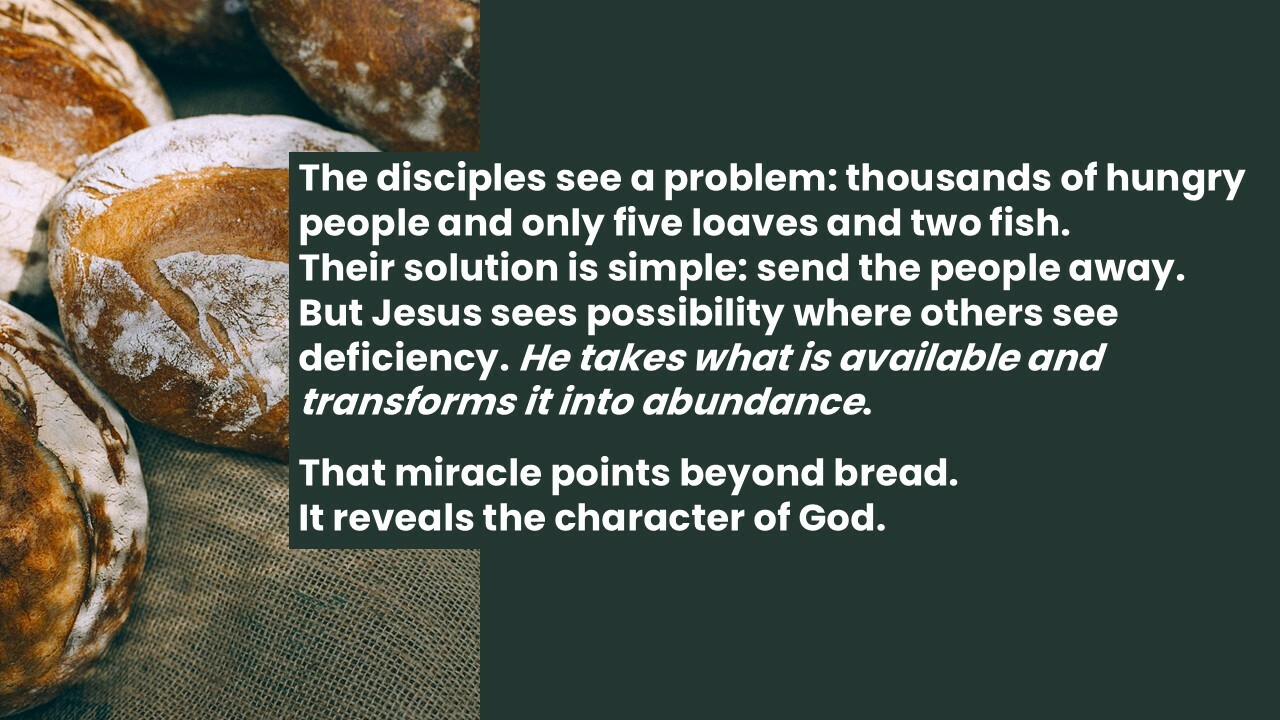
The disciples see a problem: thousands of hungry people and only five loaves and two fish. Their solution is simple: send the people away. But Jesus sees possibility where others see deficiency. He takes what is available and transforms it into abundance.
That miracle points beyond bread. It reveals the character of God.
God has always been the One who feeds people in the wilderness. The God who provided manna for Israel is the same God present on that hillside and the same God present with us today. The answer to human hunger has never been scarcity—it has always been God's presence.
As we gathered around the Communion table, we remembered the familiar pattern: Jesus took, blessed, broke, and gave. We bring our grief, fears, doubts, and limited resources, and Christ transforms them through grace.
The story ends with twelve baskets left over. Not barely enough. More than enough.
And that is the good news we needed this weekend: in a world that often takes life, Jesus keeps giving it. His kingdom is not built on scarcity but on abundance, not on fear but on compassion, not on death but on overflowing life.