From Doulos to Pais

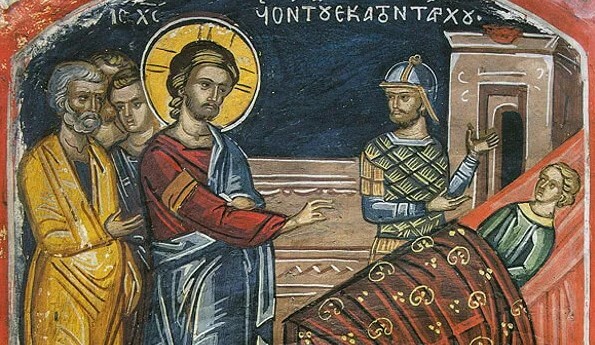
In Luke’s telling of the story (Luke 7:2), the man who is sick is named with a common word: doulos—a servant, a slave.
That word tells us how the world saw him.
He had a role. A function. A place in the system.
And in many ways, we still speak that language today.
People become categories: employee, outsider, problem, statistic.
We say: “That’s just a worker…”
“That’s just a kid…”
“That’s just someone on the margins…”
The world is very good at naming people by what they do…
and very poor at seeing who they are.
But the story shifts when the centurion speaks.
In Matthew’s account (8:6), he uses a different word:
“My pais…”
Pais can mean servant, but also child, beloved, someone held in closeness.
The same person—
but a different name, a different heart.
Where others saw a doulos,
he saw my pais—someone who mattered to him.
The difference between doulos and pais
is the difference between using someone and loving someone.
And it raises a question for us:
Who in our lives has been reduced to a label?
Who needs to be seen again—not as role, but as relationship?
Jesus responds by marveling at the centurion’s faith.
Not just because he understands authority,
but because he embodies compassion.
He sees dignity.
He uses his power for the sake of another.
He speaks a different word about a life others have already defined.
And healing flows.
Jesus heals the one
some called doulos
and one man called pais.
Maybe the miracle begins
not when Jesus speaks a word of healing…
but when we start speaking a different word about one another.
In God’s kingdom, no one is just a doulos.
Every person is a pais—
beloved, seen, and worth crossing boundaries for.