When Faithfulness Doesn’t Raise Its Voice

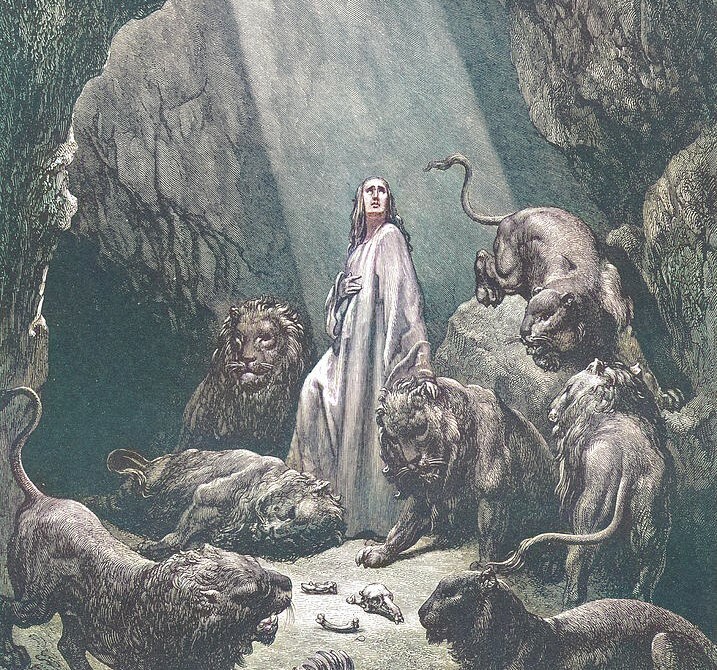
A reflection on Daniel 6
Some stories grow quieter the longer we sit with them. Daniel and the lions is one of those. What once felt like a dramatic rescue scene now reads more like a study in restraint—faith that does not announce itself, argue for itself, or try to manage the outcome.
Daniel hardly speaks at all in this chapter. That may be the most unsettling part.
In a world that rewards reaction—outrage, performance, constant explanation—Daniel’s silence feels almost foreign. He does not scramble to save himself or stage a public defense. He does not raise his voice when the rules change or try to outmaneuver the system closing in around him. He simply goes home and prays, the way he always has.
There is something deeply disarming about that kind of steadiness.
The story suggests that faithfulness, when practiced daily and without spectacle, eventually becomes unsettling to anxious systems. Daniel’s problem is not belief; it is consistency. His life exposes the fragility of those who require control to feel secure. And when fear runs the show, integrity starts to look like a threat.
What strikes me is that Daniel’s prayer does not fix anything. The law remains. The conspiracy holds. The king wrings his hands but does nothing brave. Faithfulness here has no leverage. It cannot stop injustice from advancing. It cannot guarantee protection.
That alone challenges a deep assumption many of us carry—that faith is meant to function as a kind of spiritual insurance. Pray correctly, live rightly, and outcomes will align. Daniel quietly refuses that logic. His prayer seems less about asking God to intervene and more about refusing to let the situation re‑write his inner life.
Perhaps prayer, in its truest form, is not about producing change but about preserving orientation—keeping the soul facing the right direction when circumstances are determined to turn us inward on ourselves.
God’s action in the story comes late. Too late, we might say, from a practical point of view. Daniel is already in the den before anything shifts. The miracle is not preventative; it is sustaining. God does not save Daniel from danger so much as remain with him within it.
That distinction matters. Especially to those who are praying faithfully and finding no visible interruption of their suffering.
The lions feel very modern. Not the animals themselves, but what they represent: diagnoses that don’t go away, systems that don’t bend, losses that prayer does not reverse. Daniel offers no formula for escape. What he offers instead is a way of being human in fear without becoming ruled by it.
On this side of the resurrection, we know even more clearly that faithfulness is not a guarantee of rescue. It is, however, a way of staying aligned with the God who brings life where death seems certain.
Most of us will never face a literal den. But we will face moments when the faithful choice does not make us safer, louder, or more successful—only truer. And the question Daniel leaves us with is not whether God can save, but whether we can live faithfully without needing proof that God will.
Sometimes the bravest faith is the kind that doesn’t raise its voice at all, it just turns to God as it always has.