What Does Agape Look Like Today?

Yesterday we reflected on Mary's extravagant act of pouring perfume on Jesus' feet. It was an act of love so lavish that Judas immediately questioned its practicality. Why spend so much? Why waste such a valuable gift?
Yet Mary's response reminds us that love does not always operate according to ordinary calculations.
In John's Gospel, we discover something surprising about God's love. When Lazarus became ill, Mary and Martha sent word to Jesus:
"Lord, he whom you love is ill."
Their assumption was understandable. If Jesus loved Lazarus, surely He would come immediately and heal him.
Instead, John tells us:
"Now Jesus loved Martha and her sister and Lazarus. So he stayed two days longer in the place where he was."
Because He loved them, He waited.
Because He loved them, He allowed them to walk through grief.
Because He loved them, He offered them something greater than healing. He offered resurrection.
Philia wants healing. Agape seeks resurrection.
Not because healing is bad. We all pray for healing. We all long for relief from pain and suffering. But healing restores what was. Resurrection creates something new.
That causes me to wonder:
What does agape look like in our world today?
Agape looks like a parent who continues loving a struggling child when quick fixes have failed.
Agape looks like a friend who sits quietly beside someone who is grieving, not attempting to solve their pain but refusing to let them face it alone.
Agape looks like a recovery sponsor who patiently walks alongside someone through setbacks and failures, believing that transformation is still possible.
Agape looks like a church that welcomes people not because they have everything together, but because God is still at work within them.
Agape looks like forgiveness when resentment seems easier.
Agape looks like hope when cynicism feels more reasonable.
Agape looks like staying present when walking away would be simpler.
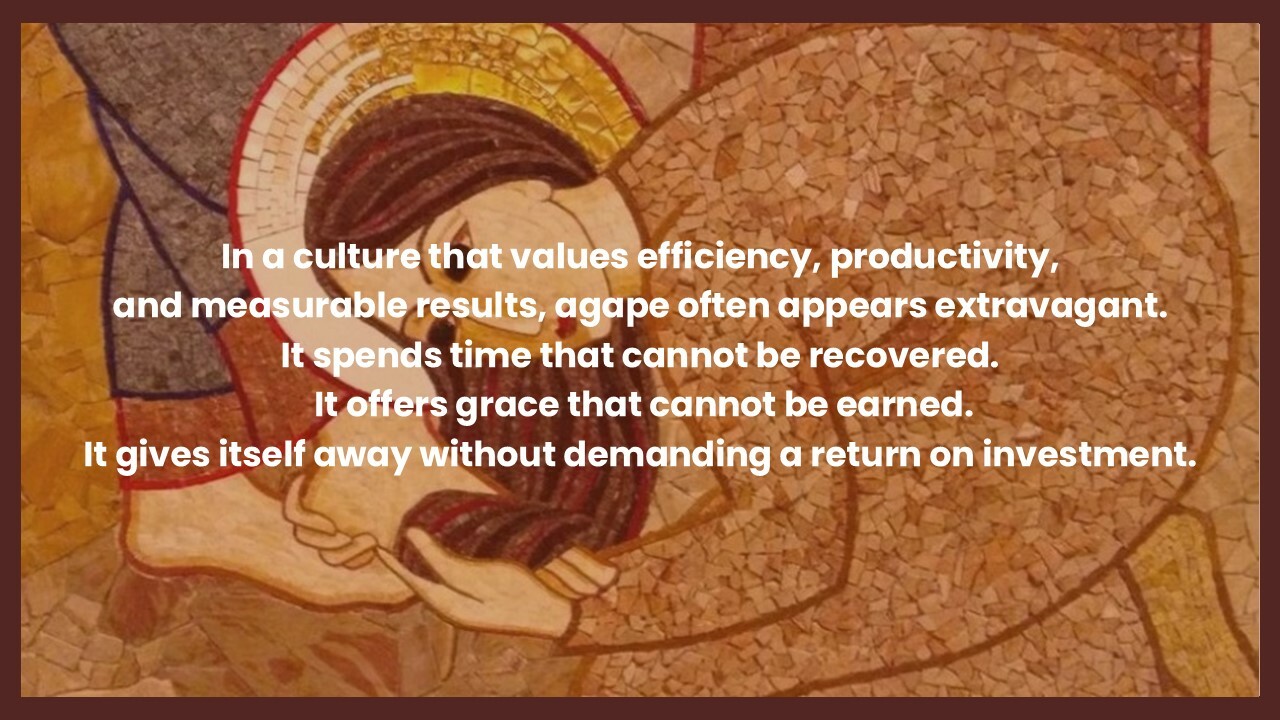
In a culture that values efficiency, productivity, and measurable results, agape often appears extravagant. It spends time that cannot be recovered. It offers grace that cannot be earned. It gives itself away without demanding a return on investment.
Judas asked, "What is it worth?"
Mary asked, "What is He worth?"
That may be one of the central questions of discipleship.
The world often asks what something costs.
Love asks what someone is worth.
And because every person is beloved of God, agape keeps showing up. It keeps serving. It keeps forgiving. It keeps hoping.
Ultimately, agape is not merely something we do. It is something we receive. We learn to love this way because this is how Christ has loved us.
Mary's perfume filled a house with fragrance.
Jesus' self-giving love fills the world.
Whenever we choose mercy over judgment, presence over abandonment, hope over despair, and compassion over calculation, a little more of that fragrance enters the air.
Perhaps that is what agape looks like today.
Not grand gestures alone.
But ordinary people carrying the fragrance of resurrection into a world that desperately needs to know that love's final answer is not fear, not loss, and not even death.
Who in your life right now needs not just healing, but the patient, resurrection-seeking love of agape?