For Such a Time as This

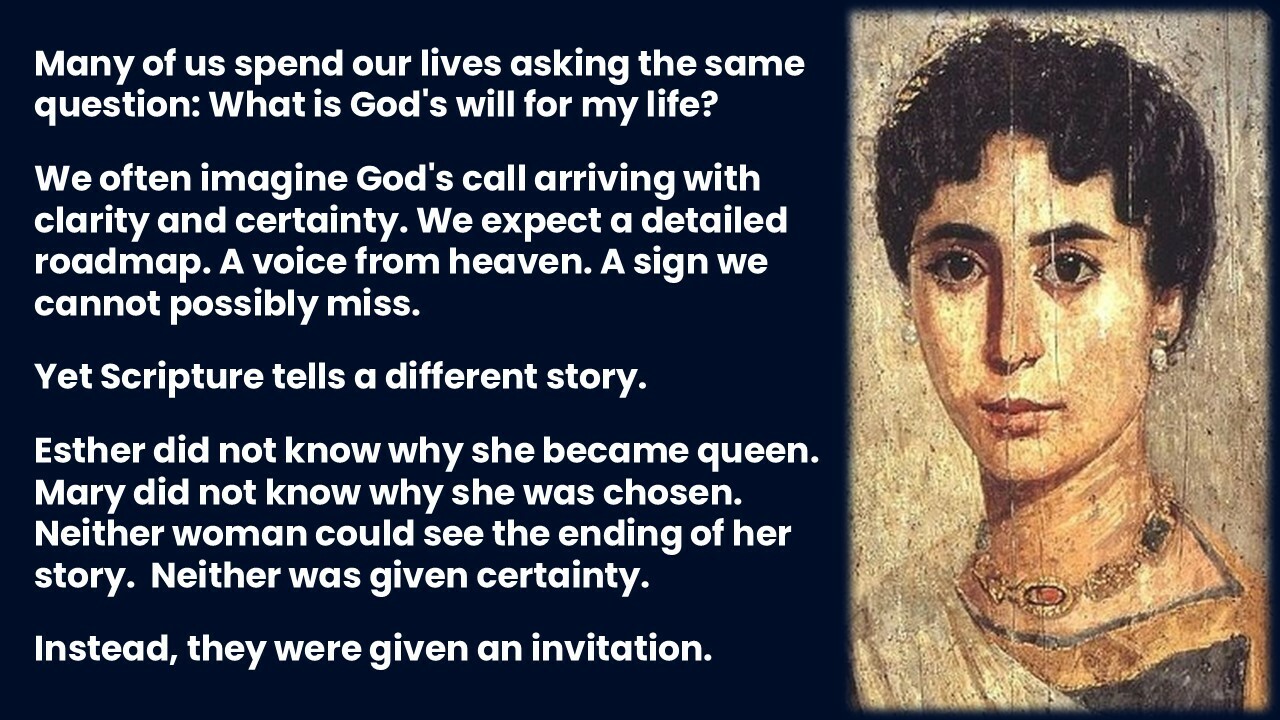
Many of us spend our lives asking the same question:
- What is God's will for my life?
We often imagine God's call arriving with clarity and certainty. We expect a detailed roadmap. A voice from heaven. A sign we cannot possibly miss.
Yet Scripture tells a different story.
- Esther did not know why she became queen.
- Mary did not know why she was chosen.
- Neither woman could see the ending of her story. Neither was given certainty.
Instead, they were given an invitation.
One of the most fascinating things about the book of Esther is that God's name never appears. Not once. And yet God seems to be everywhere. God is present in a dismissed queen and a young orphan girl named Hadassah. God is present in a sleepless king, an overlooked record book, a delayed conversation, and a simple banquet invitation. The whole story feels like a whisper: While we are living our ordinary lives, God is quietly weaving together circumstances we do not yet understand.
Author Kathy Khang reflects on a moment early in the story when Esther learns that her cousin Mordecai is grieving in sackcloth and ashes. Her first response is surprisingly human. She sends him clothing.
Khang wonders if Esther was embarrassed by what she saw. Perhaps she wanted to solve the appearance of the problem before facing the pain beneath it. Perhaps she hoped the discomfort would simply go away.
Many of us do the same.
We rush toward solutions before we sit with sorrow. We try to tidy what feels messy. We want to make everything better. But vocation often begins when we stop looking away. Esther's calling does not emerge at the beginning of the story. It appears in the middle, in the midst of confusion, fear, and crisis. That may be one of the most comforting truths in this book.
Most of us are not handed our life's purpose in advance.
- We discover it while living.
- We recognize it while responding.
- We see it only as the story unfolds.
When Mordecai urges Esther to act, his words are remarkably uncertain:
- "Who knows? Perhaps you have come to royal dignity for just such a time as this."
- Notice what he does not say.
He does not claim special knowledge.
He does not announce God's plan with confidence.
He simply says, "Who knows?"
Faith often lives in that space. We long for certainty. God often offers possibility.
Looking back, many of us can identify moments that prepared us for something we could not yet imagine.
- A teacher who believed in us.
- A difficult season that strengthened us.
- A friendship that broadened our perspective.
- A job we almost did not take.
- A loss that deepened our compassion.
At the time, these moments seemed ordinary. Later, they looked like preparation. Perhaps this is what testimony really is. Testimony is not simply telling what happened. It is learning to recognize grace in the rearview mirror. It is looking back and realizing God was at work before we understood what God was doing.
Esther also reminds us that the ordinary may be holier than we realize.
- There is no burning bush in this story.
- No parted sea.
- No pillar of fire.
- Only everyday events.
The book suggests that God's presence is often hidden inside the routines of our lives.
- In phone calls.
- In hospital waiting rooms.
- In friendships.
- In disappointments.
- In ordinary Tuesdays.
The God of Esther is not absent. The God of Esther is hidden. And perhaps the same is true in our own stories. Yet preparation is not enough. Position is not enough. At some point Esther must choose. She must risk everything. And so she utters one of the bravest lines in all of Scripture: "If I perish, I perish."
The miracle is not simply that Esther found herself in the right place at the right time. The miracle is that she said yes.
Many people are prepared for a calling. Far fewer have the courage to embrace it. Providence may open the door. Courage walks through it. This is where Esther and Mary meet.
- One says: "If I perish, I perish."
- The other says: "Let it be with me according to your word."
Different words. The same surrender. Neither woman knows what lies ahead. Neither receives guarantees.
Both place themselves in God's hands. Both become instruments of deliverance for others. And ultimately both stories point beyond themselves. Esther risks her life to save her people. Jesus gives his life to save the world. In Esther we see courage. In Christ we see courage brought to completion through self-giving love.
So perhaps the question is not, "What is my purpose?"
Perhaps the better question is:
- How is God preparing me today for something I cannot yet see?
Because one day someone will need encouragement. A child will need guidance. A neighbor will need compassion. A community will need leadership. A church will need courage. And in that moment we may discover that what looked like coincidence was actually grace. What seemed random was preparation.
That what appeared ordinary was holy ground. Then we may hear again Mordecai's ancient question:
- "Who knows? Perhaps you have come to this place for just such a time as this."
The question is not whether God has been at work. The question is whether we will have the courage to answer. For God is the God of now. Not merely the God of yesterday's memories or tomorrow's possibilities.
The God of this moment. This invitation. This decision.
And perhaps this very day is one of those moments.