Be the community

Beloved friends,
Come with me to the tomb of Lazarus. Look carefully. The stone has been rolled away. The air is heavy with grief. Martha and Mary stand nearby with hearts worn thin by sorrow. Four days have passed. Hope itself seems buried. And yet Christ stands before the tomb.
Not as a visitor to death.
Not as one defeated by death.
But as its Lord.
Many marvel at what happens next. A dead man walks out of a grave. And rightly so. It is a wondrous sign. Yet if we stop there, we miss what the evangelist wishes us to see.
Lazarus is not resurrected in the way Christ will be resurrected.
Lazarus returns to the life he knew before. He will eat again, laugh again, speak again. He will embrace his sisters and return to his home. But one day he will face death again.
Christ's resurrection is different.
When Christ rises, death loses its throne. The grave loses its claim. A new creation begins.
Therefore the raising of Lazarus is not merely a miracle. It is a signpost pointing beyond itself. It reveals who Jesus truly is.
Earlier in the story, Jesus declares, "I am the resurrection and the life." Notice carefully that He does not say, "I bring resurrection," though He does. He does not say, "I know resurrection," though He does. He says, "I am the resurrection." Resurrection is not merely something Christ performs. It is what Christ embodies.
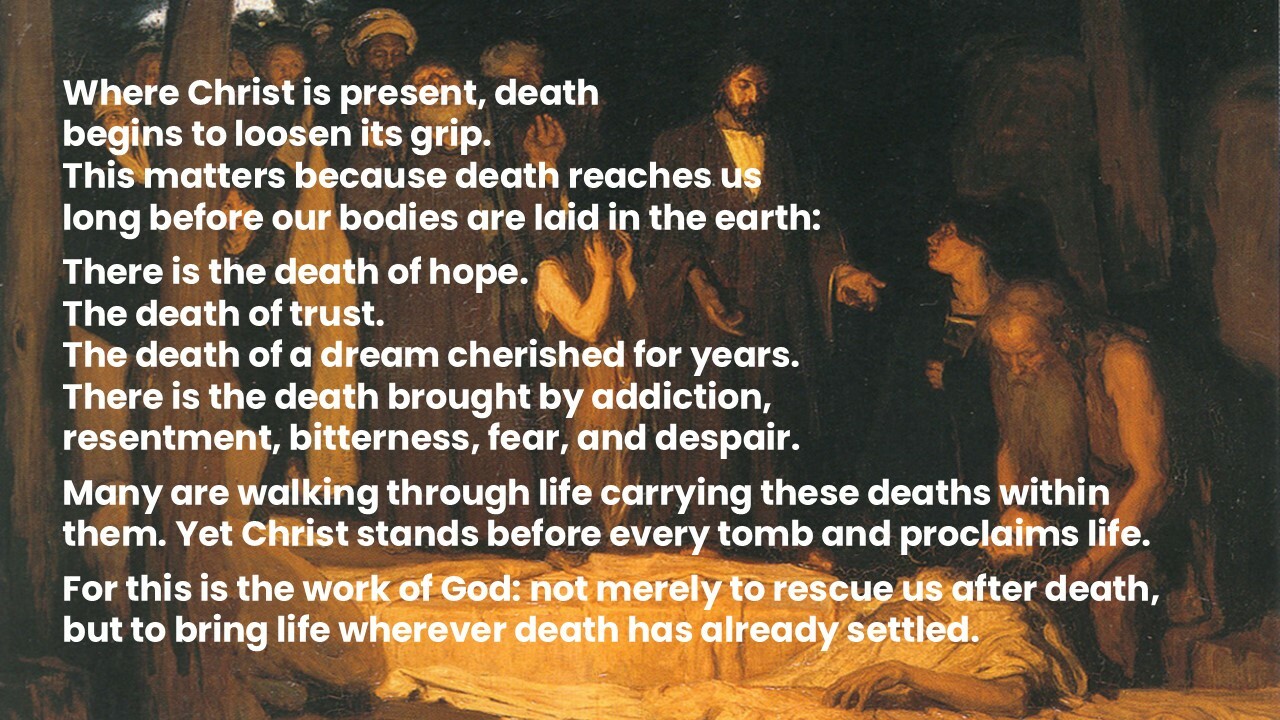
Where Christ is present, death begins to loosen its grip. This matters because death reaches us long before our bodies are laid in the earth:
There is the death of hope.
The death of trust.
The death of a dream cherished for years.
There is the death brought by addiction, resentment, bitterness, fear, and despair.
Many are walking through life carrying these deaths within them. Yet Christ stands before every tomb and proclaims life. For this is the work of God: not merely to rescue us after death, but to bring life wherever death has already settled.
Before Jesus calls Lazarus forth, something else happens.
Jesus weeps.
What a mystery!
The One who knows He is about to raise Lazarus still weeps. Why?
Because love never remains distant from suffering. The tears of Jesus reveal the very heart of God.
God is not indifferent to our pain.
God does not watch our grief from afar.
God enters it.
God shares it.
God weeps with those who weep.
Then, standing before the tomb, Jesus cries out:
"Lazarus, come out!"
He calls him by name.
Not "Whoever is in there."
Not "Someone come out."
"Lazarus."
The voice of God has always been personal. Samuel was called by name. Moses was called by name. The prophets were called by name. The Good Shepherd calls His sheep by name.
So it is here.
Christ does not summon an anonymous crowd from death. He calls a beloved friend.
And He calls each of us in the same way.
He knows the story we carry.
He knows the wounds we hide.
He knows the places where fear and shame have built their tombs.
Still He calls. Still He invites. Still He speaks life.
Yet notice what happens when Lazarus emerges.
He is alive.
But he is not yet free. His hands remain bound. His feet remain bound. A cloth still covers his face. Death has lost its power over him, yet the marks of death still cling to him.
Is this not our story as well?
Many of us have heard Christ's call. Many of us have tasted grace. Many of us have experienced new life.
And yet we continue to wear our grave clothes. Some are wrapped in anger. Others in jealousy. Others in fear. Others in shame. Some are bound by old wounds that have never healed. Others are trapped by the need to control everything around them. These are not merely sins to be counted. They are grave clothes that restrict the life God longs to give. A person cannot run while wrapped in burial cloths. Nor can we walk fully into God's future while wrapped in resentment, anxiety, pride, or despair.
But hear the good news:
Christ does not stand at a distance and say, "Try harder."
He calls us by name.
He calls us into freedom.
And then comes one of the most remarkable moments in the story.
Jesus raises Lazarus.
But Jesus does not remove the grave clothes. Instead He turns to the crowd and says:
"Unbind him, and let him go."
The Lord gives this task to the community.
Christ raises the dead.
The people help remove the wrappings.
What a beautiful image of the Church!
The Church is not merely a gathering of people who hold the same beliefs. The Church is a community of the risen learning how to live free.
We remind one another that we are beloved.
We strengthen those who are weary.
We forgive one another.
We tell the truth to one another.
We carry burdens together.
We help untie the knots of fear, shame, bitterness, and isolation.
When we do these things, we participate in the work of resurrection. And what replaces the grave clothes?
The Apostle Paul tells us.
Love.
Joy.
Peace.
Patience.
Kindness.
Generosity.
Faithfulness.
Gentleness.
Self-control.
These are not merely virtues to admire. They are the garments of resurrection life.
Friends, perhaps the question before us is this:
What grave clothes still bind us?
What fear?
What resentment?
What wound?
What false story have we continued to tell about ourselves?
The voice that echoed outside the tomb of Lazarus still speaks today. Christ is still calling people by name. Still calling people out of darkness. Still bringing life where death has taken hold. And Christ is still forming communities that help one another become free.
For resurrection is not only a promise for the end of time.
It begins now.
It begins whenever Christ calls us into new life.
It begins whenever God's people help one another leave behind the garments of death and put on the clothing of the Spirit.
So hear again the words of our Lord:
"Come out."
And hear again the calling of the Church:
"Unbind them, and let them go."
Grace and peace to you all.